


Yet another windowless room, lit by fluorescent lighting, cooled to a chilly 18ºC to keep the audience awake. Hard plastic chairs fixed in neatly arranged rows of ten, all squarely facing the stage.
There the main panel of the event unfolds in all too familiar patterns. The second panelist just got handed the microphone to answer the moderator's question. A well-structured monologue follows. Fellow panelists use the time to look at their own note cards again, occasionally interrupting themselves for a polite nod at the speaker when a brief pause in the speech seems to demand it.
After five minutes, the speaker leans back seemingly satisfied with their delivery. And so seems the moderator as she hands the mic to the next panelist.
The pattern repeats.
Two more rounds of this, and each panelist is asked to deliver their closing statements, for cinematic effect this time in reversed order. A round of applause concludes the performance and releases the audience of their polymer seats. A small number of them heads eagerly towards the panelists, business cards in hands, while others, equally rushed, hurry out of the arctic breeze of the humming aircon they've sat under for the past hour.
The default we came to accept
I’ve been part of many such sessions, in every one of these roles: freezing in the audience, eagerly networking with the speakers, moderating through a well-rehearsed flow of signed-off questions, or responding to these within my allotted speaking time.
No matter where in the world the event took place, I observed these same patterns again and again. They felt inevitable, like universal laws governing the way events are to be run.
Many of these laws emerge from the self-imposed constraints of the event’s aspirations: A must-attend summit of thought leaders and industry experts promising key insights any CXO must know. With that kind of promise, you don’t want to leave things up to chance. So you book space in an exhibition center or an impressive downtown office, secure high-profile speakers and sponsors, and pack the agenda with as many parallel-run sessions as the venue can hold (content pre-submitted and signed off, of course).
Familiar choices, predictable outcomes.
Always slightly overwhelming in the setup and underwhelming in the results. Intriguing on paper and exhausting in reality. This setup feels like a safe bet for organizers, the commercially straightforward and established model.
And so it does for participants, too.
For organizational leaders, used to overscheduled diaries and back-to-back commitments, the default event structure is a natural extension of their habitual modus operandi. Anything else, say, white space of unstructured time, would feel wasteful, almost indulgent.
That’s how we got stuck with this design as the default, despite it barely yielding any genuinely new insights or significant breakthroughs.
When things go off script
As I did my rounds through the halls, pavilions, and congress centers, going through the well-rehearsed motions of the well-trodden conference path, I started to notice brief moments in which the familiar patterns got interrupted.
In between the carefully curated sessions and outside of the official agenda — actually mostly outside of the venue altogether — people just happened to meet. And talk. And connect.
At the restaurant right next to the main entrance of the exhibition center — Oh, your organization too has experienced this issue? While queuing for an over-prized (but much needed) cup of coffee — I’ve never thought about it that way but now that you say it… Or during an improvised picnic lunch, stealing oneself away from the noisy halls — That’s so interesting, why has nobody ever tried this approach?
Soon, these rare moments stood out as the most memorable ones of all the conferences I attended. Often, they were the beginning of new collaborations, projects, and partnerships.
For instance, at one of the UN COPs, I happened to be early for an evening reception, wandering the rooms of a (inappropriately luxurious — think golden eagle bathroom sink faucets) villa where it was being held. There, I bumped into another seemingly equally lost guest. Having time to kill before the reception began, we started to chat. Not knowing anything about each other’s backgrounds or current workplaces, we had a refreshingly candid conversation about what we believed is truly at the heart of the environmental crisis.
We have now been working together for over two years in a non-profit whose purpose is to address exactly those foundational, structural deficits we discussed that evening.
During another week-long climate summit, my colleague and I found our way to a local restaurant, after an exhausting day of running from one panel and roundtable to the next. The place was packed, but a stranger was kind enough to let us join him at his table, and we naturally started to chat. While I thought I had no more energy left inside me after that day (and prior to some food), I suddenly found myself deeply engaged in the exchange with the stranger. As it turned out, he moved to this town a few years back and is managing the local office of a major international financial institution. While he had nothing to do with the climate summit, his organization was doing work in the space. The perspective he shared from inside the industry was eye-opening, and completely absent from the rooms I’d been in all day.
That single exchange had me rethink some of the most dearly held beliefs about why things are stuck in the industry and, most importantly, how they can get unstuck. Years later, I am still in touch with that stranger, acting as honest sounding boards for each other’s work.
Experiences like these, which offered new perspectives and led to breaking through barriers that seemed insurmountable before, made me wonder two things: One, what makes these encounters work? And second, how could we create more of these — not by accident, but by design?
From accidents to intention
Let’s start with what makes them work. The answer I’ve found is surprisingly simple. These moments work so well because they catch us off guard. When we are outside of our known professional environment. Physically and mentally.
They happen when we are in a Liminal Space.
Liminal Spaces exist on the threshold between the familiar and the unknown. We enter them when the patterns of our everyday are interrupted and things that tend to occupy our working memory are temporarily forgotten.
Leaving the conference halls, the meeting rooms, the place we associate with work, we lay down the armor of organizational identities that we’re otherwise wearing all day and the rather rigid thinking that comes with it. In these moments — strolling the streets of a foreign city or visiting a new restaurant after the last session has closed — our minds are not set to work mode anymore. We open up different channels of thinking and behavior.
Ironically, these are exactly the ones we need to tap into for some of our most important work to progress. And Liminal Spaces are where they become accessible.
Naturally, unhurriedly, effortlessly.
Which brings me to the second question: Can we move these moments from being rare fortunate accidents to intentionally designed encounters? Not as an afterthought of events or as another item on their agenda. What if we skipped the big venues, the uninspiring rooms, the predictable panels altogether? What if the event actually were these encounters?
Designing Liminal Spaces
Just as we can intentionally enter Liminal Spaces ourselves by interrupting our familiar patterns, so we can also intentionally design them for others to enter. If the goal is to create such Liminal Spaces that allow for meaningful, honest connections to emerge — like the serendipitous encounters described above — we have to think about the container that’s supposed to hold them. Three dimensions shape this container:
the physical environment around us,
the mental frame inside of us, and
the people alongside us.
Conferences address two of these by offering a physical environment that’s different from your office and bringing you together with different people. But while they check these two boxes on paper, the majority of conferences do not turn them into a setup conducive to real connections and meaningful encounters. They do not open up a Liminal Space but rather dress up familiar patterns in new clothes.
Crucially, they rarely trigger a shift in your mental frame, which remains rigidly fixed in familiar territory. Locked in like this, you could sit next to your (professional) soul mate or listen to a breakthrough idea delivered on center stage, while you remain blissfully oblivious to either as your mind is occupied with all the things it’s been ruminating on since you left your office the day before.
The key insight is that the three dimensions need to come together in a very particular way. They all need to click, simultaneously. If and when they do, they form a Symbiotic Container: the Liminal Space in which people feel safe enough to show up as actual, vulnerable humans, not their corporate identities.
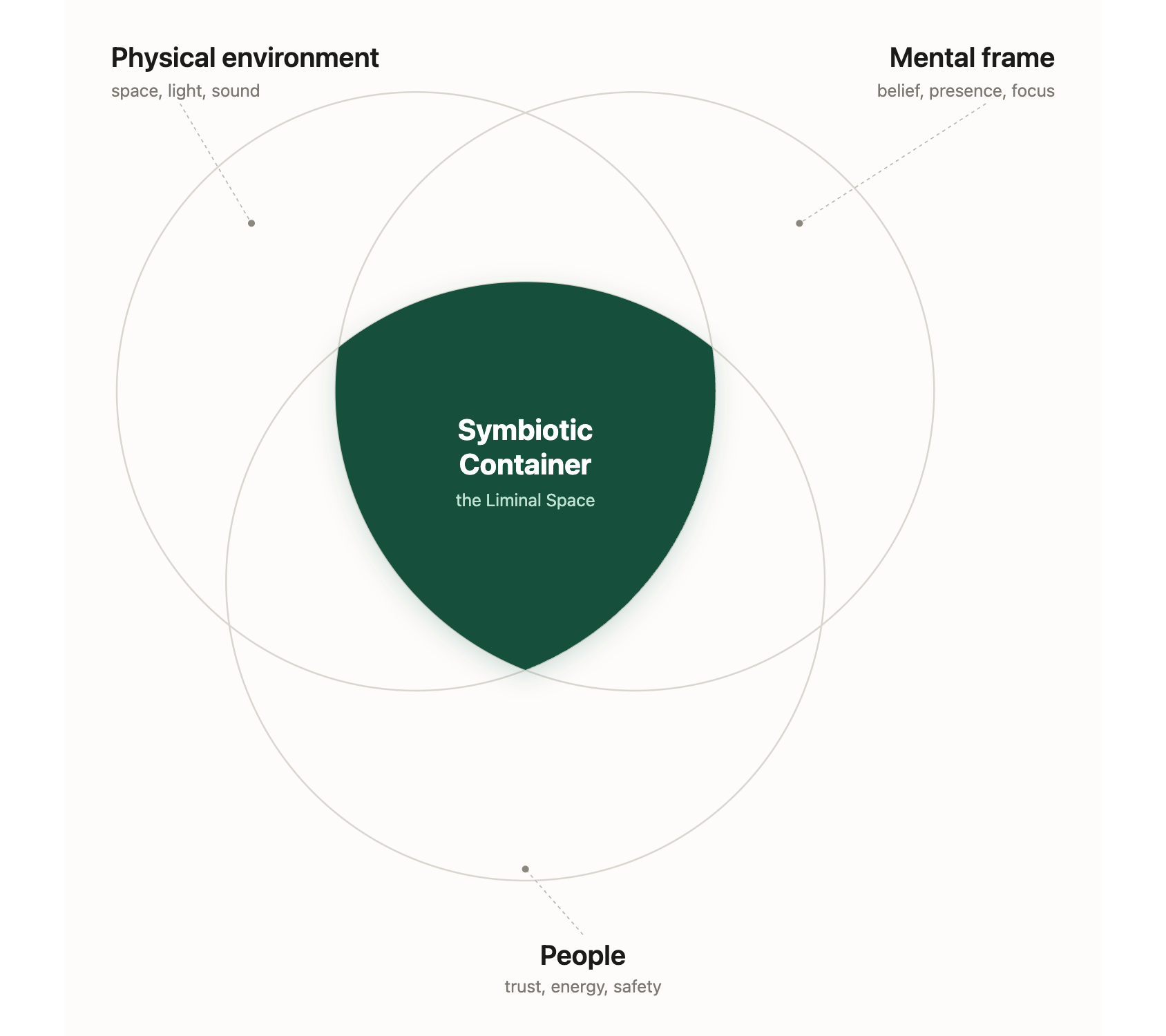
In this Liminal Space, people trust to genuinely connect with one another, to address challenges that normally remain unnamed, and, without even being prompted, create new paths forward.
1. Your physical environment
You have certainly experienced yourself how the physical space you’re in — the light in the room, the noises around you, the smells, the air — can profoundly shift every aspect of your being. There are spaces that immediately make you feel comfortable, safe, that put you at ease. They feel inviting, warm, inspiring. And there are those that elicit just the opposite reaction in you: they put you on alert, they feel cold, your body contracts, they feel draining.
Decades ago, researchers have already found that our attention is a finite resource.1 It depletes over the course of a day. But it can be restored: Walks in nature, with effortless, wandering outward attention let your brain’s attention system rest and restore. While nature is the most direct path to this, the same mechanism can be triggered by other environments that let the mind stay engaged without draining its attention resources: strolling through places of art or history, enjoying a calm moment in a cozy café, watching people pass by on the street.
Most of our office spaces, let alone conference venues, are rarely designed with this research in mind. While dozens of workplace studies demonstrate the importance of unstructured social spaces for creativity and innovation, in practice, they seem to hit their ceiling of imagination at ping-pong tables and a few comfy chairs.
Carefully designed unstructured spaces for informal encounters, and deliberate breaks in nature, are the two longest, most accessible levers you can pull to set the conditions for progress on your stuck points and long awaited breakthroughs on your knotty problems.
2. Your mental frame
Closely related to the physical space you find yourself in, it’s easy to see how a room not only affects you physically but also mentally. Your body and mind are inherently interconnected. If the former contracts and shifts to fight-or-flight mode (constant noise-scape of city traffic and construction sites; freezing, window-less room with glaringly bright lights), your mind will do just the same.
The opposite holds true, too: If your body is at rest and open, your mind suddenly starts to open up. Creativity flows, new connections are made, inspiration sparks. The physical state of your body, influenced by the physical space you’re in, and your mental frame are in a symbiotic relationship with one another, constantly checking in on each other: are we safe?
Once there’s a clear yes, anything is possible.
What this can look like in practice was shown by a team of Harvard researchers:2 They told one group of hotel housekeepers that their daily cleaning already met the Surgeon General’s exercise guidelines, while a second group was given no information. Four weeks later, with no change to their actual work, the informed group’s weight, blood pressure, and body fat had all measurably dropped, just from believing differently about what their bodies were already doing.
Create the conditions for your inner frame to shift, and you can suddenly enter into places you were never even aware existed.
3. The people around you
The symbiotic relationship does not end there: the third dimension of the container, the people alongside you, significantly shapes the energy of the room you’re in and has profound effects on your mental frame.
Remember the last time you got together with a group of friends or colleagues who just naturally vibed together, conversations flowing effortlessly? Chances are, you left that table, room, or restaurant feeling uplifted and inspired, a little lighter and calm.
Now, think of a situation where the opposite was true: An uncomfortable business meeting or negotiation with a partner or manager, where all options seem to be win-lose scenarios. Or the seemingly endless argument with a naysayer who keeps listing all the reasons why your idea just cannot work.
The exhaustion, and possibly relief, you felt when leaving those rooms and people behind is real, mentally and physically. Being in situations like these with these types of people depletes your capacity for clear thinking and effective doing. They put you on constant alert, with no emotional safety in sight.
Compare that to the first scenario: When you are feeling safe in the company of the people around you. When you are feeling heard and seen by your peers. That’s when you and they open up, when you are having honest conversations, and dare to bring your true self to the interaction.
You are not only shaped by the five people you spend the most time with generally. You’re shaped by the five people with you in the room right now.
Dare to design for outcomes
When a Symbiotic Container opens up, things feel effortless. There’s no thought of work though you might just be working through some of your knottiest problems.
Designing Liminal Spaces to create these conditions is not easy. It requires clarity about the purpose of the container one wants to create, awareness of how its three dimensions can be shaped to serve this purpose, and energy to bring them to life.
That’s why they are so rare.
They are expensive, not necessarily in monetary terms, but in the time and effort one spends designing them. They require intention and devotion. Both by those designing them and those entering them. For someone whose value is tied to visible output, as is the case for most organizational leaders, an hour that produces no deliverable feels like failure even when it’s the most productive hour of the trip.
I’ve given a few examples of Symbiotic Containers emerging as serendipitous encounters — those that happen once conference lanyards are stashed away and strangers bump into each other while decompressing at a local restaurant.
But we have the opportunity to create these intentionally, too. And I strongly believe we need more of them, urgently. Not as an escape from the real world, but as a catalyst for real progress. Both for the individuals entering the Liminal Spaces and those outside of them who will be at the receiving end of the new potential and outcomes created inside of them.
If you are leading a team, an organization, or a community of some kind, I’d encourage you to experiment with the three dimensions of the container — the physical environment, mental frame, and people. For instance, before your next off-site or full-day team meeting, ask what in the room is actually working against the conversation you want to have.
If you’re gathering people for creative brainstorming, can you do that elsewhere than in a large, sterile meeting room? Or, if your aim is for the team to grow closer and open up about what’s actually not working, would a longer walk outside do more for that conversation than another hour in the office?
Change one thing about the physical space on purpose. Discover what combination of space, mental state, and people can open up a Liminal Space, where all three dimensions are in sync with each other and feed off of one another.
After my own experiences, and experiments, with Liminal Spaces, I became convinced that they are the missing piece for many leaders who feel stuck on a problem.
You don’t have to wait for the next serendipitous encounter, though. You can decide that the windowless room isn’t good enough anymore.
Continue with…
Kaplan Stephen. The restorative benefits of nature: Toward an integrative framework. Journal of Environmental Psychology, Volume 15, Issue 3, 1995, Pages 169-182, https://doi.org/10.1016/0272-4944(95)90001-2.
Crum AJ, Langer EJ. Mind-set matters: exercise and the placebo effect. Psychol Sci. 2007 Feb;18(2):165-71. doi: 10.1111/j.1467-9280.2007.01867.x. PMID: 17425538.